

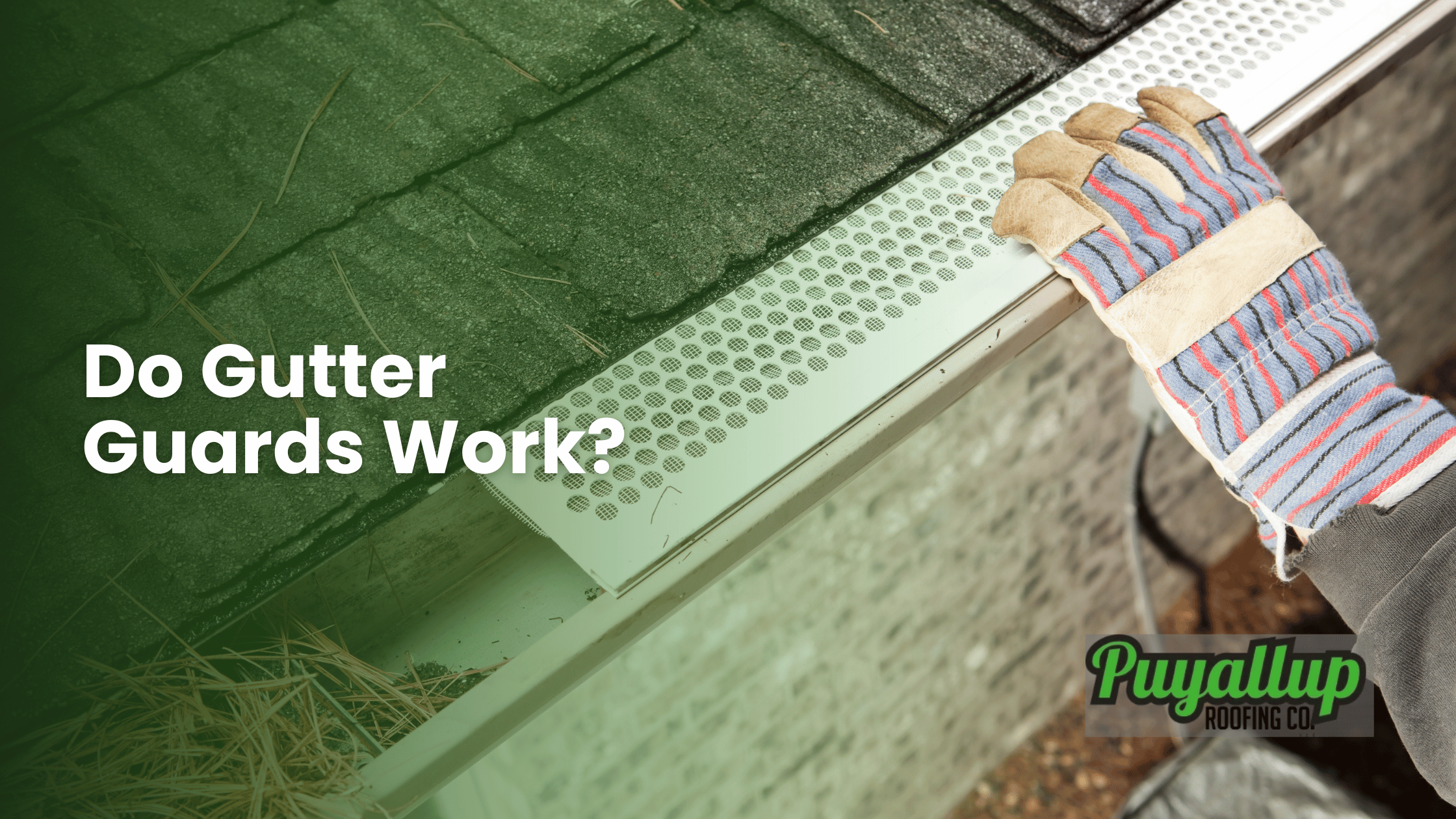
Do Gutter Guards Work?
Do gutter guards work well enough to justify installing them? In many Western Washington homes, the answer is yes, but only when the right guard system is matched to the roof, surrounding trees, and existing gutters. Quality guards can reduce clogs, improve water flow, and make maintenance easier. They do not, however, turn gutters into a completely maintenance-free system.
Key Takeaways
- Gutter guards block most leaves, twigs, seed pods, and larger debris.
- They reduce gutter cleaning but do not eliminate it.
- Fine debris, roof granules, pollen, and pine needles may still collect.
- Micro-mesh guards usually provide better filtration than brush or foam products.
- Poor installation can cause water to overshoot the gutter during heavy rain.
- Existing gutters should be cleaned, inspected, and properly pitched before installation.
- Guards are most valuable for homes near trees or with difficult-to-reach rooflines.
How Gutter Guards Actually Work
A gutter guard covers or fills the open top of a gutter while allowing rainwater to enter. Leaves and other debris are directed away, caught on the surface, or prevented from settling inside the channel.
Without gutter protection, organic material can collect in the gutter and form a dense, wet blockage. Water then backs up or spills over the edge instead of moving through the downspout and away from the home.
A well-designed guard system reduces the amount of material that reaches the bottom of the gutters. That helps maintain a clearer path for water during the rainy season.
What Gutter Guards Can Keep Out
Depending on their design, guards may block:
- Large leaves
- Fir needles and pine needles
- Twigs
- Seed pods
- Moss fragments
- Animal nesting material
- Some roof debris
No filter blocks every particle. Small granules from asphalt shingles, dust, pollen, and decomposed organic matter can still pass through mesh or settle along the edges.
Why the Type of Debris Matters
A home beneath broadleaf trees has a different problem from a home surrounded by firs or cedars. Large maple leaves are relatively easy for many guards to stop. Narrow evergreen needles can enter larger openings, wedge into screens, or create a mat across the top.
This is why choosing a gutter guard based only on price can lead to disappointment. The guard needs to match the debris that actually lands on the roof.
Do Gutter Guards Work During Heavy Rain?
Yes, properly selected and installed gutter guards can handle normal and heavy rain. Their performance depends on the amount of roof runoff, the guard design, the gutter size, and whether the downspouts are clear.
Rain does not fall directly into the gutter alone. Water collects across the entire roof surface and moves rapidly toward the eaves. A steep or complex roof can send a concentrated stream of water toward one short section of gutter.
If the mesh is clogged, the gutters are undersized, or the guard sits at the wrong angle, water may flow over the edge instead of entering the gutter system.
Signs Water Is Overshooting the Guards
Watch the gutters during steady rain. Common warning signs include:
- Sheets of water passing over the gutter edge
- Water falling near the foundation
- Staining on siding or fascia
- Soil erosion beneath the roofline
- Water collecting near doors, walkways, or landscaping
- Dripping behind the gutter
These symptoms do not always mean the gutter guards are defective. The problem may be incorrect gutter pitch, a blocked downspout, loose fasteners, poor installation, or insufficient drainage capacity.
Comparing the Main Types of Gutter Guards
Different guards solve different problems. Understanding the basic designs can help you avoid a system that looks convenient but creates more maintenance later.
| Type | How It Works | Best Use | Main Limitation |
|---|---|---|---|
| Micro-mesh | Fine metal mesh filters water and debris | Homes near trees and fine debris | Surface may require brushing or rinsing |
| Perforated screen | Openings block larger leaves and twigs | Moderate leaf coverage | Needles and small debris may pass through |
| Surface-tension cover | Water follows a curved edge into the gutter | Large leaves and open rooflines | Heavy runoff may overshoot |
| Brush insert | Bristles sit inside the gutter | Simple DIY applications | Debris can become trapped in the bristles |
| Foam insert | Porous foam fills the gutter | Short-term or low-debris situations | Organic matter can settle and break down inside |
Micro-Mesh Gutter Guards
Micro-mesh gutter guards use very small openings to filter out leaves, needles, and other material. They are often a practical option for homes with heavy tree coverage.
The mesh still needs inspection. Moss, pollen, or wet leaves can form a layer over the surface and slow water entry. That material is usually easier to remove from the top than from the bottom of clogged gutters.
Screen and Perforated Guards
Metal or plastic screens are widely available and can provide useful gutter protection from larger debris. Their wider openings may be less effective against fir needles, seeds, and small roof particles.
Lightweight screens can also shift, lift, or become distorted if they are not secured correctly.
Brush and Foam Guards
Brush and foam products are often promoted as easy DIY solutions. They may reduce large debris inside a gutter, but they can also hold smaller material where it decomposes.
In a damp environment, trapped organic matter may support moss growth or create a muddy layer. These products can work in limited situations, but they should not be treated as permanent, maintenance-free solutions.
Do Gutter Guards Eliminate Gutter Cleaning?
No. Gutter guards reduce cleaning, but every guarded gutter system still needs periodic inspection and maintenance.
Instead of cleaning gutter channels filled with compacted leaves, you may need to remove debris from the guard surface, check corners, and flush the downspout. This is usually simpler, but it is not the same as never cleaning gutter components again.
What Maintenance Is Still Required?
A practical gutter maintenance routine includes:
- Inspecting guards after major windstorms.
- Removing leaves or branches resting on top.
- Checking valleys where roof runoff carries concentrated debris.
- Confirming that water enters the gutter instead of overshooting it.
- Flushing downspouts when drainage appears slow.
- Looking for loose fasteners, sagging sections, or separated seams.
Homes beneath mature trees may need several visual checks each year. Homes with little nearby vegetation may require less frequent cleaning.
When Gutter Guards Are Worth Installing
Gutter guards are most valuable when they solve a specific, repeated problem. They are not automatically necessary for every home.
Installation may be worthwhile when:
- Trees regularly fill the gutters with leaves or needles.
- The roof is high, steep, or difficult to access safely.
- Clogged gutters have caused repeated overflow.
- The homeowner wants to reduce ladder use.
- Commercial buildings require more predictable water control.
- Regular gutter cleaning has become difficult to schedule.
- The home has roof valleys that direct debris into certain areas.
A home with few nearby trees, a simple one-story roof, and easily accessible gutters may not receive the same benefit.
A Common Western Washington Scenario
Consider a home with fir trees near one side of the roof. The front gutter may stay relatively clear, while the rear gutter repeatedly fills with needles and moss fragments.
Installing the same inexpensive screen across the entire home may not solve the rear drainage problem. A better approach is to evaluate the debris load, roof pitch, runoff points, gutter condition, and downspout placement before choosing a guard system.
That property-specific assessment is often more important than the product name printed on the box.
Problems Gutter Guards Cannot Fix
Gutter guards can prevent debris-related clogs, but they cannot correct an existing drainage or roofing defect.
Guards will not fix:
- Gutters pitched in the wrong direction
- Gutters that are too small for the roof
- Rotted fascia boards
- Loose or failing fasteners
- Poorly placed downspouts
- Underground drain blockages
- Roof leaks
- Damaged flashing
- Water flowing behind the gutter
Installing guards over failing gutters can hide the original issue without resolving it. Before gutter installation, the existing system should be cleaned and inspected for damage, pitch, secure attachment, and proper drainage.
Professional Installation Versus DIY
Some gutter guards are designed for DIY installation, particularly on low, accessible rooflines. However, working near a roof edge carries fall risks, and incorrect installation can interfere with water flow or roofing materials.
Professional installation is more appropriate when the home has:
- A two-story or steep roof
- Complex roof valleys
- Metal roofing
- Uneven or damaged gutters
- Heavy tree coverage
- Commercial drainage requirements
- Existing overflow or fascia damage
A professional can also determine whether replacement is more sensible than attaching guards to an aging gutter.
Choosing the Right Gutter Guard System
The best gutter guard is not necessarily the product with the smallest holes or the strongest sales claim. It is the system that supports reliable drainage on your specific home.
Before making a decision, consider:
Existing Gutter Condition
Guards should not be installed over clogged gutters, separated seams, or sagging sections. Repairs or replacement may be needed first.
Roof and Gutter Compatibility
The guard must fit the gutter profile and allow water to move naturally from the roof edge. Installation should not damage shingles or interfere with the roof’s drainage path.
Nearby Trees
Broad leaves, evergreen needles, blossoms, moss, and seed pods behave differently. Choose a mesh or cover suited to the most common debris.
Access for Future Maintenance
A guard system should be serviceable. Ask how sections are removed, lifted, rinsed, or inspected if a blockage develops.
Workmanship and Warranty
The long-term performance of guards depends heavily on installation. Review both the product warranty and the workmanship coverage, including what maintenance is required to keep them valid.
Get an Honest Gutter Assessment from Puyallup Roofing Company
Puyallup Roofing Company brings decades of combined construction and roofing experience to residential and commercial gutter services. The team installs gutters and gutter guards with attention to drainage, durability, and the needs of each property, without high-pressure sales.
Contact Puyallup Roofing Company at (253) 201-8034 or info@puyalluproofing.com.
The office is located at 6411 72nd Street East, Puyallup, WA 98371, serving Puyallup and surrounding Western Washington communities. Contact us to schedule a free, no-obligation estimate.
Frequently Asked Questions
Are gutter guards worth it if I still have to clean them?
Yes, they can still be worthwhile because they reduce the amount of debris entering the gutters and make maintenance easier. Their value is highest on tree-covered properties or roofs that are difficult to access.
Can gutter guards cause water to overflow?
Poorly selected, clogged, or incorrectly installed guards can contribute to overflow. The gutters may also be undersized, poorly pitched, or connected to blocked downspouts.
Do gutter guards work with pine needles?
Micro-mesh guards can block many pine and fir needles. Larger screens, brush inserts, and some surface covers may allow needles through or trap them on the guard.
How often should gutters with guards be checked?
Inspect them at least in spring and fall, as well as after major windstorms. Homes with heavy tree coverage may need more frequent checks to keep the guard surface and downspouts clear.
Can gutter guards be installed on old gutters?
Sometimes, but only when the existing gutters are secure, properly pitched, and free of significant corrosion or damage. Weak gutters should be repaired or replaced before guard installation.
Do gutter guards prevent ice dams?
No. Guards may help keep drainage paths clearer, but ice dams are usually related to roof temperature, insulation, ventilation, snow, and freezing conditions. Gutter protection alone cannot solve them.
Protect Your Home with Better Water Control
Gutter guards work best as one part of a complete drainage system, not as a substitute for proper gutters or maintenance. For a recommendation based on your roof, trees, and water-flow needs, contact Puyallup Roofing Company at (253) 201-8034 and schedule your free estimate.