

How Long Should a Roof Last?
If you are wondering how long should a roof last, the most useful answer is a range, not a single expiration date. An asphalt roof may serve a home for around 20 to 30 years, while well-installed metal, tile, or slate roofing can last considerably longer. Material matters, but installation quality, ventilation, flashing, drainage, weather exposure, and maintenance can change that timeline significantly.
For homeowners in Puyallup and across Western Washington, long wet seasons create additional challenges. Shaded areas can stay damp, gutters can fill with debris, moss can establish itself, and repeated wind and rain can expose weak roofing details. A roof that still looks acceptable from the driveway may already have aging flashing, moisture issues, or ventilation problems underneath.
A Quick Guide to Roof Lifespan
Before focusing only on your roof’s age, keep these points in mind:
- Asphalt shingles commonly provide roughly 15 to 30 years of service depending on the product and conditions.
- Metal, tile, and slate roofs generally have much longer potential lifespans.
- A manufacturer’s warranty is not the same as guaranteed roof life.
- Proper ventilation and drainage can influence how quickly roofing materials deteriorate.
- Flashing and penetrations may fail before the main roofing surface.
- Repeated repairs on an aging roof can eventually become less practical than replacement.
How Long Should a Roof Last by Material?
Most residential roofing materials can provide decades of useful service when installed correctly and maintained appropriately.
The National Roofing Contractors Association provides roofing guidance covering roof systems, materials, maintenance, and factors that affect long-term performance.
| Roofing material | Typical planning range |
|---|---|
| Three-tab asphalt shingles | 15 to 25 years |
| Architectural asphalt shingles | 25 to 30+ years |
| Wood shingles or shakes | 20 to 40 years |
| Metal roofing | 40 to 70+ years |
| Clay or concrete tile | 50 to 100 years |
| Slate roofing | 60 to 100+ years |
These ranges should be treated as planning estimates rather than promises.
The NRCA roofing materials guidance also shows why different roofing systems age differently. Asphalt shingles, metal, tile, wood, and slate each respond differently to moisture, temperature changes, impact, installation conditions, and maintenance.
A 30-year roofing warranty does not mean a roof is guaranteed to perform perfectly for exactly 30 years. Warranty coverage and actual service life are different things.
Why Can Two Roofs of the Same Age Look Completely Different?
Two roofs installed in the same year can have very different amounts of useful life remaining.
Imagine two homes with 18-year-old architectural shingles.
One roof has good attic ventilation, properly installed flashing, clean gutters, little tree coverage, and no history of leaks.
The second sits beneath large trees. Its north-facing slope remains damp for long periods, moss is growing between shingles, gutters regularly overflow, and several areas have already been repaired.
Both roofs are technically 18 years old, but their conditions are not comparable.
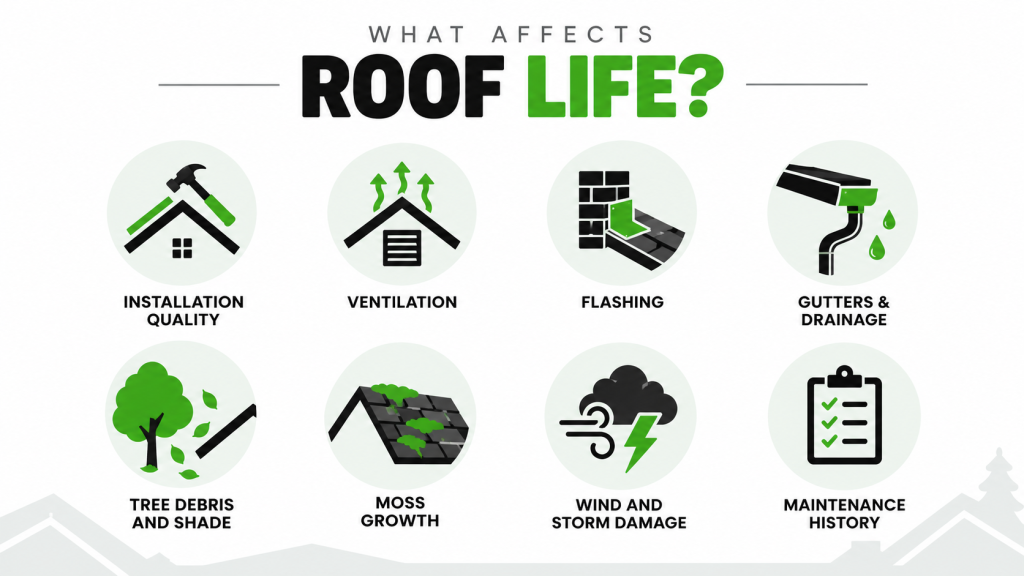
Several factors influence how long should a roof last in real-world conditions:
- Installation quality
- Correct shingle fastening
- Underlayment installation
- Chimney and wall flashing
- Skylight and vent penetrations
- Attic ventilation
- Roof pitch
- Gutter performance
- Tree coverage and debris
- Moss growth
- Wind exposure
- Previous storm damage
- Maintenance history
Ventilation is particularly important.
The Asphalt Roofing Manufacturers Association explains how proper attic ventilation helps manage heat and moisture that could otherwise contribute to deterioration within the roof system.
Your Shingles Are Only One Part of the Roof
One common mistake is deciding that a roof is healthy simply because the shingles still look reasonably good.
A roofing system contains much more than the surface material.
Roofers may also examine valleys, flashing, penetrations, roof edges, gutters, ventilation, underlayment, and accessible decking. A roof can sometimes develop problems around these details long before every shingle appears worn out.
For example, water may enter around chimney flashing or a plumbing vent while most of the surrounding shingles remain intact.
That is why asking how long should a roof last becomes much more useful when paired with another question:
Is the entire roofing system still performing properly?
One missing or damaged shingle does not automatically mean you need a new roof. Localized damage on an otherwise healthy roofing system may be repairable.
However, several leaks, widespread deterioration, repeated flashing problems, soft decking, extensive granule loss, or repairs appearing across multiple areas can indicate that the roof is moving closer to replacement.
Practical tip: Do not use an interior ceiling stain as your first roof inspection. Moisture can affect underlayment, decking, insulation, and framing before water becomes obvious inside the home.
Can Storms Shorten a Roof’s Lifespan?
Yes. Severe weather can shorten roof life, especially when damage is not detected early.
Strong wind can loosen or lift shingles. Falling branches can damage roofing materials or decking. Wind-driven rain can expose vulnerable flashing. Debris can interfere with drainage and keep sections of the roof wet.
Age also affects how roofing materials respond to severe weather.
The Insurance Institute for Business & Home Safety researches asphalt shingle durability and how aging affects roofing performance under damaging conditions.
After severe weather, simply checking whether all the shingles are still visible is not always enough. Damaged seals, displaced flashing, punctures, lifted tabs, or impact damage may be harder to spot from ground level.
When Does Roof Repair Stop Making Sense?
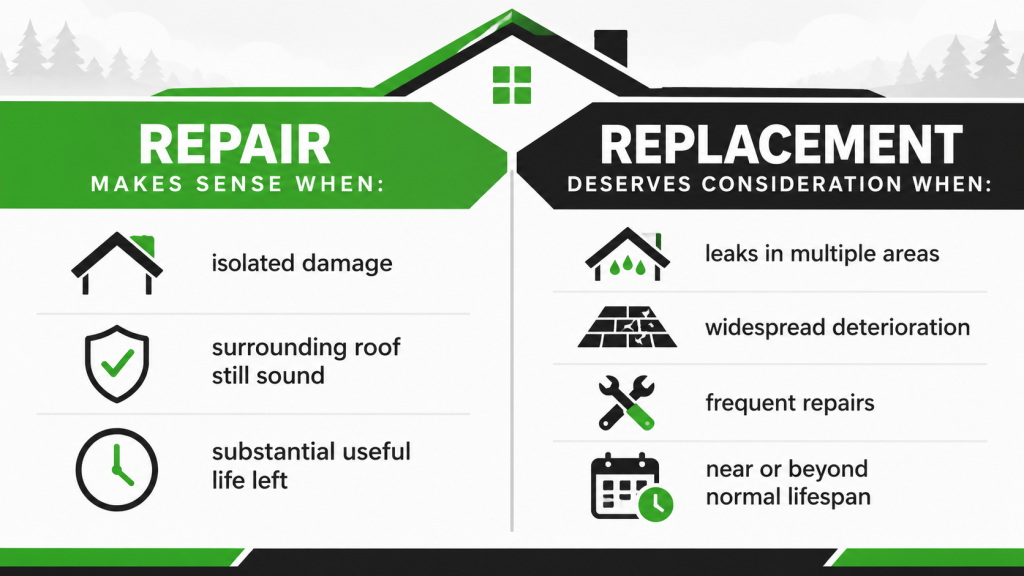
Repair often makes sense when the problem is isolated and the surrounding roofing system still has substantial useful life.
For example, repairing several damaged shingles on a relatively young roof may be straightforward.
The decision becomes different when an older roof starts requiring repairs in multiple locations.
Consider a 25-year-old asphalt roof that has already developed leaks around a vent, a valley, and one section of flashing. Fixing each individual problem may temporarily stop water intrusion, but it does not reverse the aging taking place throughout the rest of the roof.
Replacement may deserve consideration when:
- Leaks keep developing in different areas
- Large sections of shingles are deteriorating
- Shingles are extensively cracked, curled, loose, or missing
- Granule loss is widespread
- Flashing problems are recurring
- Roof decking has moisture damage
- Repairs are becoming frequent
- The roof is already near or beyond the normal lifespan for its material
Age alone should not make the decision, but age combined with widespread deterioration often tells a clearer story.
How Puyallup Roofing Helps Evaluate an Aging Roof
Puyallup Roofing works with homeowners who are trying to decide whether their roof needs another repair or whether replacement is becoming the more practical option.
That distinction matters. An aging roof does not automatically require complete replacement. Sometimes a localized repair can still provide years of additional service. In other situations, repeated leaks or deterioration across several sections indicate that continuing to patch individual problems may only postpone a larger project.
The company provides residential and commercial roofing services throughout King, Pierce, and Thurston counties. Services include roof replacements, roof repairs, emergency tarp-offs, gutters, and gutter guards, which allows several parts of the property’s water-management system to be considered when roofing problems are investigated.
When the age of a roof is uncertain or it is approaching its expected lifespan, a professional assessment can help identify issues involving shingles, flashing, drainage, ventilation, storm damage, and other roofing components.
Why Choose Puyallup Roofing?
- More than 50 years of combined roofing expertise
- Owens Corning Platinum Preferred Contractor
- Certified IKO roofing contractor
- Licensed, bonded, and insured in Washington
- Washington contractor license PUYALRC777CL
- Residential and commercial roof repair and replacement services
Find Out How Much Life Your Roof Has Left
You do not have to wait for water to start dripping through the ceiling before checking an older roof.
If your roof is approaching its expected lifespan, has needed repeated repairs, or is showing signs of deterioration, having its condition evaluated can give you a much clearer idea of what to plan for next.
Puyallup Roofing serves homeowners and businesses throughout Puyallup and communities across Pierce, King, and Thurston counties. You can get in touch and request a free, no-obligation estimate to determine whether your roof still has useful life remaining, needs targeted repairs, or is approaching replacement.
Frequently Asked Questions
Can a 20-year-old roof still be good?
Yes, a 20-year-old roof can still be serviceable when the roofing material, installation, ventilation, and overall condition remain good.
The age should encourage closer inspection, but it does not automatically mean the roof needs replacement.
Should I replace an old roof before it leaks?
Sometimes replacing an aging roof before active leakage develops can be worthwhile when widespread deterioration is already present.
Doing so may also reduce the risk of moisture reaching decking, insulation, ceilings, and other parts of the structure.
Does a lifetime roofing warranty mean the roof lasts forever?
No. A lifetime warranty does not mean the physical roofing system will last forever.
Coverage depends on the manufacturer, product, installation requirements, exclusions, transfer rules, and how warranty protection changes as the roof ages.
Does moss mean my roof needs replacement?
No, moss by itself does not automatically mean the roof needs replacement.
However, extensive moss combined with lifted, brittle, damaged, or deteriorated shingles may indicate that the roof needs closer professional evaluation.
Can replacing individual shingles extend an older roof’s life?
Yes, individual shingle replacement can extend the useful life of a roof when damage is isolated and the surrounding roofing remains sound.
If shingles keep failing throughout different areas, repeated spot repairs may become less practical.
How can I find out how old my roof is?
Check previous inspection reports, roofing invoices, permits, warranty documents, property records, or information from the previous homeowner.
When the installation date cannot be confirmed, a roofing professional may still be able to estimate the roof’s stage of aging from its material and physical condition.